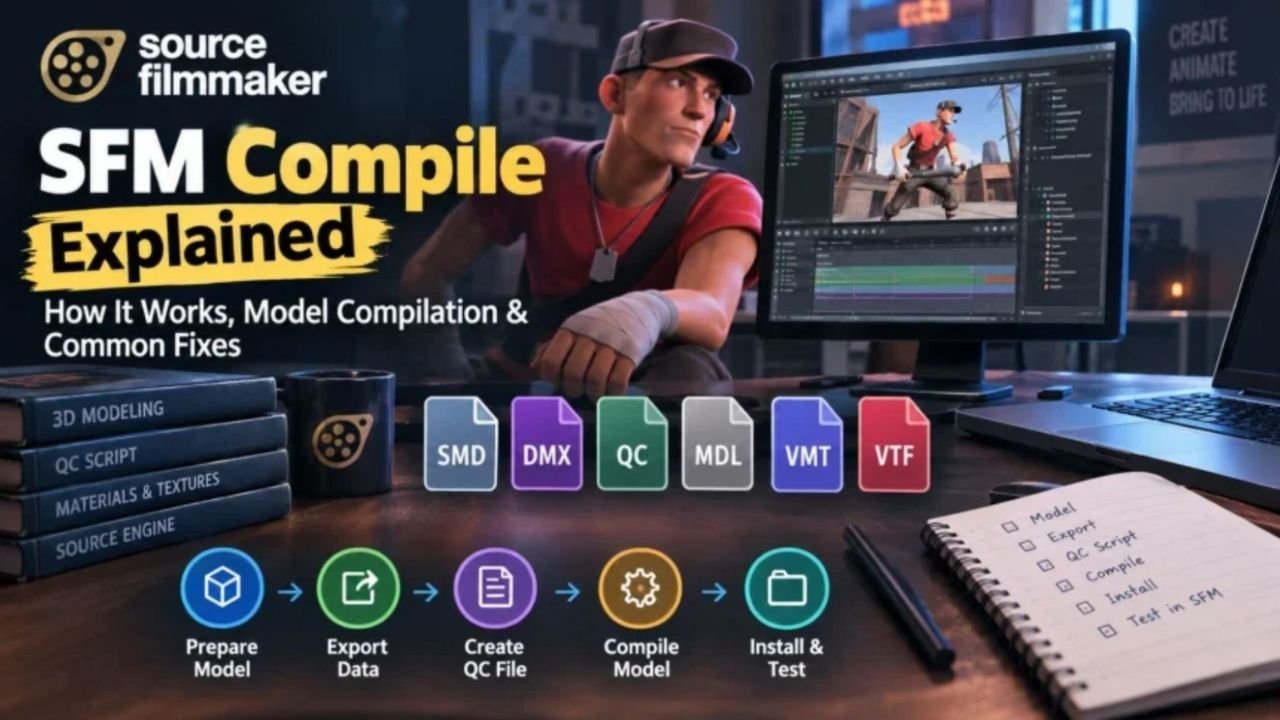
Creating custom characters, props, and animations in Source Filmmaker (SFM) can be exciting until your 3D model fails to load or displays a purple-and-black checkerboard. The problem often comes down to SFM Compile, the process that prepares external assets for Valve’s Source engine. Whether you create models in Blender, Maya, or 3ds Max, understanding compilation helps you bring custom content into your SFM projects.
This beginner-friendly SFM Compile guide for 2026 explains essential tools like Crowbar, Studiomdl, and VTFEdit, along with QC files, SMD and DMX exports, VTF textures, and VMT materials. You’ll also learn how to compile models, organize files, fix common errors, and test custom assets inside Source Filmmaker.
Understanding SFM Compile and Why It Matters
- What SFM Compile means in Source Filmmaker
- Why external 3D models need preparation before working in SFM
- How model compilation connects Blender with the Source engine
- Difference between compiling a model and rendering an animation
- Types of custom assets that can be prepared for SFM
Essential Tools and Software for SFM Compile
- Crowbar for compiling and decompiling Source models
- Studiomdl.exe for compiling Source-compatible model assets
- Blender and Source Tools for preparing and exporting models
- VTFEdit for converting textures and preparing materials
- Notepad++ for editing QC scripts
- Source SDK documentation and other useful resources
SFM Compile Process: Understanding the Complete Workflow
- Creating or obtaining a 3D model
- Preparing geometry, UV mapping, and materials
- Setting up skeletons and animations when required
- Exporting models into SMD or DMX formats
- Preparing VTF textures and VMT material files
- Writing QC compiler instructions
- Running the model compiler
- Checking compiled files and testing inside SFM
SFM Compile at a Glance: Important Files and Formats
Include a quick-reference table covering:
| Aspect | Details |
| 3D modeling software | Blender, Maya, 3ds Max |
| GUI compilation tool | Crowbar |
| Model compiler | Studiomdl.exe |
| Common source files | SMD, DMX |
| Compiler instructions | QC |
| Compiled model files | MDL, VVD, VTX |
| Physics-related file | PHY |
| Texture format | VTF |
| Material definition | VMT |
Step-by-Step Guide to Using SFM Compile
Step 1: Prepare Your 3D Model
- Check geometry and mesh topology
- Apply scale, rotation, and location transforms
- Review UV mapping and materials
- Prepare bones and skeletons for animated models
Step 2: Export Models as SMD or DMX Files
- Configure Blender Source Tools
- Export reference meshes and skeletons
- Export animation sequences when needed
- Check file names and exported data
Step 3: Convert Textures and Configure Materials
- Understand VTF and VMT formats
- Convert PNG or TGA images using VTFEdit
- Prepare matching material definitions
- Verify texture names and material paths
Step 4: Create and Configure the QC File
- Understand the purpose of QC scripts
- Define model names and output locations
- Reference the correct SMD or DMX files
- Configure material directories
- Add animation sequences when required
- Check file paths and compiler instructions
Step 5: Compile Your Model Using Crowbar or Studiomdl
- Load the QC file into Crowbar
- Configure the appropriate compilation settings
- Run the compilation process
- Review Studiomdl messages and compiler logs
Step 6: Load and Test Your Model Inside SFM
- Locate the generated model files
- Place assets in the appropriate SFM directory
- Load the custom model into Source Filmmaker
- Check geometry, materials, and animations
Step 7: Troubleshoot Problems and Recompile
- Review compiler error messages
- Correct missing files and incorrect paths
- Fix material and skeleton issues
- Recompile after correcting the source files
How SFM Compile Works Behind the Scenes
- How Source Filmmaker uses Source-engine model formats
- The role of QC files in the compilation process
- How Studiomdl processes model and animation data
- Understanding MDL, VVD, VTX, and PHY files
- How materials and textures connect to compiled models
- What happens when a model is successfully compiled
Best Practices for a Successful SFM Compile
- Maintain an organized folder structure
- Apply transforms before exporting models
- Keep mesh complexity appropriate for the project
- Study working models and their QC structures
- Start with static props before attempting complex characters
- Back up original models and source files
- Test individual changes before recompiling
- Keep model, texture, and material paths consistent
Common SFM Compile Errors and Their Solutions
Include a troubleshooting table:
| Common Error | Possible Cause | Recommended Fix |
| Purple-and-black checkerboard | Missing or incorrectly referenced textures | Check VTF and VMT files |
| Model does not appear in SFM | Incorrect paths or file placement | Verify model directories |
| Compilation fails | QC syntax or missing source files | Review compiler logs |
| Distorted model geometry | Transform or mesh problems | Inspect the original model |
| Missing animations | Incorrect sequence references | Check QC animation commands |
| Model does not move | Skeleton or bone assignment problems | Inspect the rig and bone names |
| Missing materials | Incorrect material references | Verify VMT definitions |
Advanced SFM Compile Techniques for Custom Models
- Using Level of Detail (LOD) models
- Creating custom collision models
- Configuring bodygroups for interchangeable parts
- Adding facial flexes and shape key support
- Batch compiling multiple models with Crowbar
- Improving asset organization and compilation efficiency
SFM Compile for Beginners: A Practical Learning Path
- Learn the basic Source Filmmaker interface
- Install and configure essential compilation tools
- Study an existing working Source model
- Practice compiling a simple static prop
- Progress to textured models and custom characters
- Learn skeletons and animation sequences
- Use community tutorials and Source documentation
Frequently Asked Questions
What is SFM Compile?
SFM Compile is the process of preparing 3D models, textures, materials, and animation data for use in Source Filmmaker. It converts supported source assets into Source-compatible formats using tools such as Studiomdl. This allows creators to bring custom characters, props, and other assets into their SFM projects.
What files does SFM Compile generate?
SFM model compilation commonly generates an MDL file and supporting VVD and VTX files. A PHY file may also be generated when physics or collision data is included. These files work together to make a compiled model usable in Source Filmmaker. VTF and VMT files handle textures and materials separately.
Do you need coding skills to use SFM Compile?
No advanced programming knowledge is required to get started with SFM Compile. QC files use specific compiler commands and settings rather than a general-purpose programming language. Beginners can use Crowbar’s graphical interface to run compilations, while basic knowledge of QC syntax helps when preparing custom models and fixing errors.
Why does my SFM model show a purple-and-black checkerboard texture?
A purple-and-black checkerboard usually indicates that Source Filmmaker cannot find or load the required material or texture. Check whether the VTF texture and matching VMT material exist, then verify their names, directory structure, and file paths. Recompile if necessary after correcting the relevant references.
Is Crowbar better than Studiomdl for beginners?
Crowbar is generally easier for beginners because it provides a graphical interface for compiling and decompiling Source models. Studiomdl is the underlying command-line compiler that offers more direct control over compilation. Beginners can start with Crowbar and learn Studiomdl commands as they become familiar with QC files and Source model formats.
Conclusion
SFM Compile is an essential part of bringing custom 3D models, characters, props, and animations into Source Filmmaker. By understanding the Valve Source engine, model compilation, and file formats such as SMD, DMX, QC, MDL, VVD, and VTX, beginners can build a more reliable workflow. Tools like Crowbar, Studiomdl, Blender, Maya, 3ds Max, and VTFEdit each support different stages of asset preparation, compilation, and texture conversion. Proper VTF textures, VMT materials, model paths, and QC settings also help prevent missing textures, loading failures, and other common errors. Whether you are creating static props or animated characters, testing compiled assets inside SFM is essential. With careful file organization and troubleshooting, you can make custom Source Filmmaker content ready for your projects.

I’m Asma, founder of namessaaga.com, passionate about helping brands and startups discover unique, creative, and memorable names that stand out.