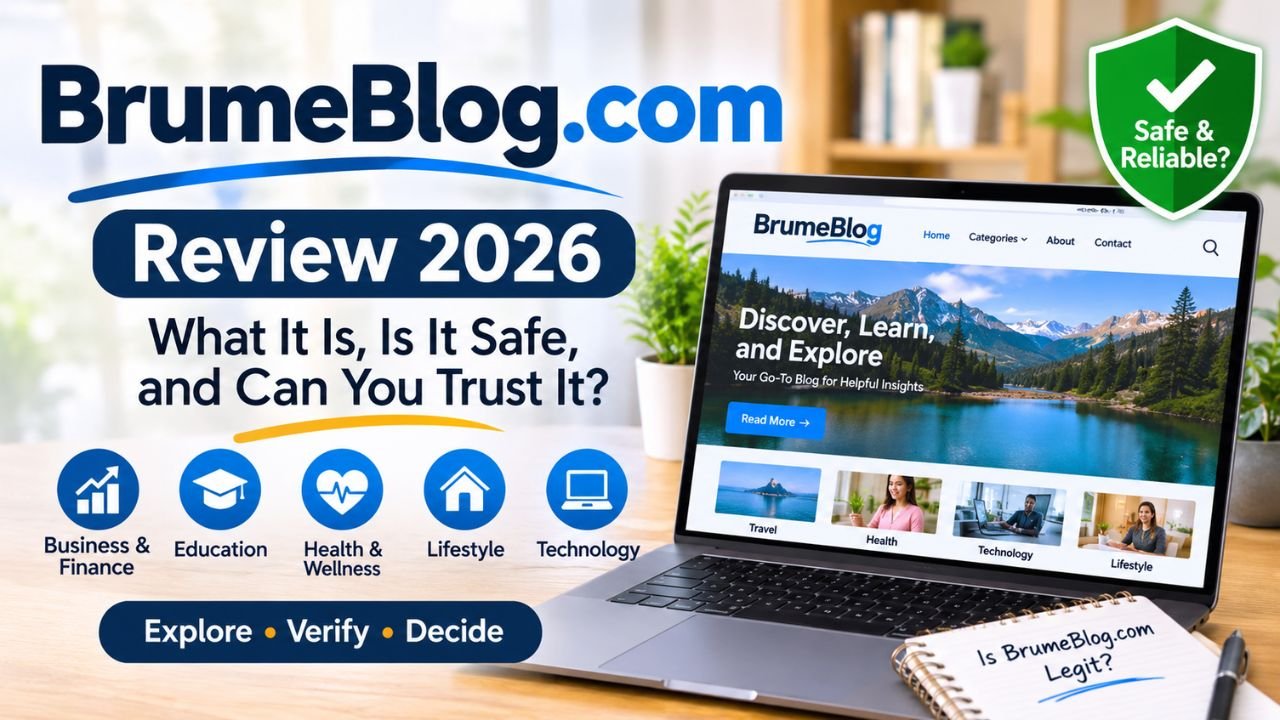
If you have come across BrumeBlog.com, you may be wondering what the website actually offers and whether its content deserves your trust. This BrumeBlog.com review for 2026 examines the multi-topic digital publishing website, its articles, and the subjects it covers, including business, finance, education, health, lifestyle, technology, travel, fashion, gaming, pets, real estate, and cryptocurrency.
We also look at website legitimacy, online safety, content quality, author transparency, and editorial credibility. Whether you are considering BrumeBlog as a research resource, publishing platform, or potential SEO backlink opportunity, this review explains what to check before relying on its information.
What Is BrumeBlog.com and What Does It Offer?
BrumeBlog.com is described in the supplied website material as a multi-topic content website. Its reported subjects include business, finance, education, health, lifestyle, technology, travel, gaming, pets, real estate, cryptocurrency, and trading.
That range suggests a general-interest publication rather than a website dedicated to one specialist subject. Readers may find introductory information across different categories, although the quality and usefulness of each article need to be assessed individually.
BrumeBlog.com at a Glance
The available descriptions present BrumeBlog as an online publishing destination with articles covering several areas of everyday interest. The following overview distinguishes those descriptions from details that still need direct confirmation.
| Website detail | Available information |
| Website name | BrumeBlog.com |
| General format | Multi-topic content website |
| Content type | Informational and general-interest articles |
| Described subjects | Business, education, health, technology, lifestyle, and others |
| Intended audience | General readers |
| Ownership | Not independently established here |
| Editorial policy | Requires direct verification |
| Author qualifications | Require individual verification |
| Access or pricing | Check the current website |
This distinction is important. A category list can describe a publication’s apparent focus, but it cannot establish its ownership, editorial standards, or accuracy.
Is BrumeBlog a Blog, Magazine, or Publishing Platform?
The available descriptions fit the broad category of a digital magazine or general-interest publishing website. Both terms describe websites that publish articles on different subjects for a broad audience.
The term publishing platform can mean something more specific. It may suggest that outside writers can register, submit articles, or manage their own content. Readers should check for contributor guidelines before assuming BrumeBlog offers those features.
What Topics Does BrumeBlog.com Cover?
The supplied material associates BrumeBlog with several broad content categories. These include professional subjects, personal interests, technology, entertainment, and topics that may require specialist knowledge.
A multi-category structure can be convenient for casual readers. Still, a website covering many subjects does not automatically have expert knowledge in every area. The evidence and quality of each article matter more than the number of categories.
Business and Finance
Business and finance content can introduce readers to professional topics, financial terminology, and general market concepts. Such articles may help someone understand an unfamiliar subject before looking for more detailed information.
Financial decisions require stronger evidence. Check investment, lending, tax, and trading claims against official documents, regulator guidance, and qualified financial sources. Do not treat a general-interest article as personalized financial advice.
Education
Education articles may discuss learning methods, academic subjects, digital classrooms, and developments in education. Introductory explanations can help readers understand a topic before consulting a school, university, or research publication.
For academic policies and qualifications, use the institution responsible for the information. Requirements can differ by location and change over time, so an older general article may not reflect current rules.
Health and Wellness
Health and wellness content can cover everyday habits, fitness, nutrition, and general well-being. These subjects attract readers who want accessible explanations without immediately turning to specialist medical material.
Medical information needs particular care. Check whether an article cites recognized health organizations or qualified professionals. Do not use an unfamiliar website as the sole basis for diagnosing a condition, changing medication, or choosing treatment.
Lifestyle
Lifestyle content generally deals with daily routines, personal interests, home life, and practical choices. Its value depends on whether an article provides clear information rather than repeating broad advice.
Look for relevant examples and evidence when an article makes factual claims. Personal opinions can be useful, but they should not be presented as established facts.
Technology
Technology coverage may include software, online services, digital tools, and developments in artificial intelligence. The supplied material also references Google Gemini and Google Search as technology-related subjects.
Technology information can become outdated quickly. Check the publication date and compare instructions with official product documentation. This is especially important for software settings, account security, subscription terms, and product features.
Travel and Fashion
Travel and fashion are two additional subjects associated with the website’s described content range. Travel articles may provide general destination information, while fashion pieces can discuss clothing, styling, and trends.
Verify practical details before making plans or purchases. Entry requirements, local conditions, prices, and product availability can change. Official travel authorities and retailers are better sources for current requirements and transactions.
Gaming and Online Games
Gaming content may discuss online entertainment, games, and related digital experiences. Readers looking for basic introductions or general gaming topics may find this subject area relevant.
For account security, game updates, payment issues, and platform rules, consult the official developer or platform. A general article should not replace current technical instructions from the service provider.
Pets and Real Estate
Pet-related articles may address animal care and common ownership questions. Real estate content can introduce property terminology, housing topics, and general market discussions.
These subjects can involve important decisions. Ask a qualified veterinarian about animal health, and verify property, legal, and financial information through appropriate professionals or official records.
Cryptocurrency and Trading
Cryptocurrency and trading are higher-risk subjects. Articles may explain digital assets, market terminology, and trading concepts, but readers should not assume that general explanations are reliable investment recommendations.
Check financial claims against regulator notices and primary sources. Never share passwords, wallet recovery phrases, or private keys because an article recommends a service or promises a particular return.
What Types of Articles Can You Find on BrumeBlog?
The supplied descriptions characterize BrumeBlog as a source of informational and general-interest articles. This type of publication can help readers become familiar with a subject before moving on to more detailed research.
The important question is whether an individual article provides enough useful information to answer its headline. Broad coverage is not a substitute for accurate facts, meaningful explanations, and supporting references.
Recent Articles and Topic Variety
A dated article archive can help visitors understand what a website has published and when its material appeared. Publication dates are particularly useful for subjects that change regularly, including technology, finance, travel, and online services.
A recent date does not guarantee that the information is current. Check whether the article reflects recent developments and whether its important claims still match reliable sources.
Informational and General-Interest Content
General-interest articles are most useful when they explain basic concepts in accessible language. They can define unfamiliar terms, introduce a subject, and help readers identify questions for further research.
For complex subjects, a short overview may not provide enough evidence. Use specialist publications, original research, and official documentation when you need detailed or decision-making information.
How Does the BrumeBlog.com Website Work?
The supplied material describes a conventional publishing structure involving a homepage, content categories, and individual article pages. These are common features of online publications, but the current website should be checked before making claims about its exact layout or functions.
A useful structure allows visitors to find information without confusion. Clear navigation, readable pages, and accessible policy information help readers understand the publication and move between its articles.
Homepage and Navigation
The homepage is usually the first place visitors look for information about a publication. It should make the website’s purpose clear and provide access to important categories or articles.
When visiting BrumeBlog.com, check whether the menus work, article links lead to relevant pages, and the site’s identity is easy to understand. Also look for accessible About, Contact, and policy pages.
Category-Based Browsing
Category-based browsing groups articles by subject. It can help readers find technology content, for example, without searching through unrelated lifestyle or travel pages.
Good organization depends on accurate labels. A category should reflect the material it contains rather than grouping unrelated articles under a broad heading.
Individual Article Pages
An individual article should provide enough information for readers to judge its usefulness. Relevant details include a clear headline, readable formatting, a publication date, an author byline, and references for important factual claims.
Check whether the article answers its main question. Watch for unsupported statistics, vague statements, unrelated links, and claims that cannot be confirmed elsewhere.
Authors and Publishing
The supplied material mentions the names Devin Haney and Shivi Hyde in connection with BrumeBlog content. These names should not be treated as proof of professional qualifications or verified identities without supporting author profiles.
A transparent publication makes it possible to identify who created an article and what relevant experience that person has. Contributor instructions and editorial information can also clarify how content reaches the website.
How Frequently Is New Content Published?
Publishing frequency can be assessed through dated articles and an accessible archive. These details may help readers understand whether a website has continued to publish material over time.
However, posting often does not prove quality. A smaller collection of carefully researched articles can be more useful than a large archive of repetitive or poorly supported material.
Is BrumeBlog.com Legitimate?
The question “is BrumeBlog.com legit?” requires more than checking whether its pages load. Readers should consider the website’s identity, contact information, policies, publishing practices, and the behavior of its pages.
It is also important to separate legitimacy from authority. A website may operate as a publication without proving that its articles are accurate or that its writers have specialist expertise.
What We Can Check
Start with information the website provides directly. Look for an About page, contact details, privacy policy, terms of use, author information, and any explanation of its publishing purpose.
Domain records and independent security services may provide additional context. However, technical records cannot establish whether an article is accurate or whether the people behind a website are qualified experts.
What Cannot Be Confirmed From the Website Alone
The supplied material does not independently establish BrumeBlog’s legal ownership, the qualifications of every contributor, or a complete editorial review process. Those details should not be presented as confirmed facts without supporting evidence.
Missing information is a reason to be cautious, not automatic proof of fraud. Record what the website discloses, identify what remains unclear, and avoid making stronger claims than the evidence supports.
Why Legitimacy Does Not Mean Authority
A functioning website can still publish inaccurate or incomplete information. Working links, a professional design, and an encrypted connection do not prove that a publication has reliable editorial standards.
This distinction is especially important for medical, financial, legal, and technical subjects. Use qualified professionals, primary sources, and recognized institutions when a mistake could have serious consequences.
Is BrumeBlog.com Safe to Use?
Website safety involves several separate checks. Visitors should consider the connection, domain spelling, page behavior, downloads, external links, and privacy information before sharing personal details.
No single indicator guarantees safety. A secure connection is useful, but it cannot establish the honesty of a publisher or the reliability of its articles.
Website Security
Check whether the domain is spelled correctly and whether pages behave as expected. Unexpected redirects, deceptive download prompts, unusual permission requests, and suspicious pop-ups deserve attention.
A clean-looking design is not proof of security. If a page seems suspicious, leave it and use a reputable security service to assess the domain before returning.
Does BrumeBlog.com Use HTTPS?
HTTPS encrypts information exchanged between a browser and a website. This helps protect data while it travels between the visitor and the website.
However, HTTPS does not prove that BrumeBlog.com is legitimate, safe in every respect, or editorially reliable. Fraudulent websites can also use encrypted connections, so treat HTTPS as one technical signal rather than a trust certificate.
Malware and Redirect Considerations
Unexpected downloads and repeated redirects can expose visitors to unwanted software or phishing pages. Do not install files simply because an article recommends them or displays a download link.
Check external destinations before opening them. Keep your browser and operating system updated, and use reputable security software when assessing suspicious files or websites.
Advertisements and External Links
Advertisements are common on publishing websites, but readers should distinguish paid promotions from independent editorial recommendations. An advertisement should not be treated as proof that a product or service is trustworthy.
External links also deserve attention. Confirm that a link leads to the organization named in the article, especially when it concerns payments, financial services, software, or account access.
Privacy and Cookies
A privacy policy should explain what visitor information a website collects, why it collects it, and whether it shares information with other parties. Cookie information should describe relevant tracking and preference practices.
Read these disclosures before submitting personal details. If the purpose of a data request is unclear, avoid providing sensitive information until you understand how the website intends to use it.
Safe Browsing Practices
Use basic precautions when visiting an unfamiliar website. These steps cannot guarantee safety, but they reduce common risks.
- Check the domain spelling before entering information.
- Avoid unexpected downloads and suspicious redirects.
- Do not share passwords or wallet recovery phrases.
- Review privacy and cookie information.
- Confirm important claims through independent sources.
Leave the website if it behaves suspiciously or requests information unrelated to the service you are using.
How Reliable Is the Information on BrumeBlog.com?
Content reliability depends on the evidence behind an article. Readers should consider its accuracy, author knowledge, sources, publication date, and whether it provides useful information beyond general statements.
The available descriptions do not establish that every BrumeBlog article follows a formal fact-checking process. Therefore, evaluate the individual page rather than assuming that all content has the same level of reliability.
Content Quality
A useful article answers its headline question, explains relevant details, and supports important claims. It should also distinguish facts from opinions, predictions, and personal recommendations.
Compare important statements with independent sources. Unsupported statistics, vague claims, and missing context should lower your confidence, particularly when the information could influence a decision.
Author Expertise
Different subjects require different kinds of knowledge. A writer discussing medical treatment, financial regulations, or cybersecurity should demonstrate relevant expertise or rely on credible specialist references.
Look for meaningful author biographies, qualifications, professional experience, and previous work. A byline provides accountability only when readers can connect it to a credible person and relevant background.
Sources and References
Reliable articles make important claims easier to check. Useful references may include academic research, government publications, official company documentation, recognized institutions, and primary sources.
When references are missing, readers have fewer ways to verify the information. That does not automatically make an article false, but it weakens confidence in claims that require evidence.
Content Freshness
Information can become outdated even when an article remains online. Software instructions, travel requirements, financial conditions, health guidance, and legal rules may change after publication.
Check both the publication date and any update date. Then compare important details with current official information. A recently displayed date is not enough if the underlying facts have not been reviewed.
First-Hand Experience and Originality
Original content should contribute useful analysis, examples, or first-hand knowledge. It should do more than repeat general statements that readers can find across many websites.
Originality alone does not guarantee accuracy. A personal account can be interesting but incomplete, while an original opinion can still be mistaken. Important factual claims need evidence.
Editorial Review and Fact-Checking
Editorial guidelines can explain how a publication selects topics, reviews submissions, checks facts, and corrects mistakes. A correction policy also gives readers a way to understand how errors are handled.
The supplied information does not establish a documented BrumeBlog editorial process. Check the live website for editorial guidelines, correction information, and contact details before assuming that articles receive formal review.
When to Verify Information Elsewhere
Use primary and specialist sources when information affects health, money, legal rights, security, or important professional decisions. These subjects require stronger evidence than a general-interest overview may provide.
For example, check medical guidance with recognized health organizations, legal requirements with the relevant government authority, and product instructions with official documentation. Do not rely on one unfamiliar article for high-impact decisions.
Who Writes for BrumeBlog.com?
The supplied material names Devin Haney and Shivi Hyde in connection with BrumeBlog articles. However, the names alone do not establish identity, professional experience, or editorial responsibility.
Readers should look for author pages that explain relevant experience and link to published work. Clear contributor information makes it easier to judge whether a writer is qualified to discuss a particular subject.
Authors Visible on the Website
Bylines help readers identify who is credited with an article. They also provide a starting point for checking a writer’s other work and subject knowledge.
Check whether author names connect to meaningful profiles. Avoid treating a name, photograph, or short biography as proof of professional credentials without independent support.
Author Bios and Credentials
A useful author bio explains relevant experience rather than relying on broad descriptions. A contributor writing about finance, for example, should provide evidence of relevant financial knowledge.
If a profile does not explain the writer’s background, place less weight on claims that require specialist authority. Evaluate the article’s sources and evidence instead.
Does BrumeBlog Explain Its Editorial Process?
An editorial policy can explain how articles are assigned, reviewed, sourced, and corrected. It may also clarify whether the website publishes sponsored material or accepts outside contributions.
Check the current website for these details. If they are not available, do not assume that a formal expert-review or fact-checking system exists.
Why Author Transparency Matters
Clear authorship helps readers understand who is responsible for published information. It is especially important when a website covers subjects that require specialist knowledge.
Author profiles, relevant qualifications, editorial policies, and correction channels can support accountability. When these details are limited, readers should verify important claims through stronger sources.
BrumeBlog.com Strengths and Weaknesses
A multi-topic publication may offer convenience to readers who want introductory information across several subjects. Its value depends on the quality of the articles and how clearly the website presents its information.
The main limitation of a broad publishing model is that subject variety does not demonstrate expertise. Readers should balance convenience against the need for accurate, well-supported information.
Potential Strengths
BrumeBlog’s described subject range may appeal to readers with varied interests. A general-interest format can make it easier to move between topics without visiting several separate publications.
It may also help readers identify subjects for further research. Articles are most useful in this role when they explain basic concepts clearly and provide references for important claims.
Limitations and Concerns
The available material does not independently confirm every website feature, author qualification, or editorial practice. Readers should verify these details before treating the publication as an established authority.
A broad subject range also makes individual expertise harder to assess. Articles involving medical, legal, financial, or technical matters need stronger evidence and should be checked against specialist sources.
BrumeBlog.com Compared With Specialized Websites
General-interest websites and specialist publications serve different purposes. A broad publication may introduce a topic, while a specialist source can provide technical detail, original research, or professional guidance.
The right choice depends on what you need to know. A simple definition may require an accessible overview, but a decision involving health, money, or legal responsibilities needs more authoritative evidence.
General Information vs. Expert Sources
General-interest articles can explain unfamiliar subjects in plain language. Specialist publications may provide deeper analysis, professional commentary, and references to original research or official documentation.
Neither format guarantees accuracy. Check the author, supporting evidence, publication date, and editorial standards instead of judging reliability by a website’s appearance or subject category.
Which Type of Website Should You Choose?
BrumeBlog may be worth considering for introductory reading if its articles answer your questions and provide useful evidence. Specialist sources are a better choice when you need technical depth or professional judgment.
Use government publications for official requirements, recognized health organizations for medical information, and official product documentation for software instructions. These sources can provide direct evidence that a general overview may not include.
How to Decide Whether BrumeBlog.com Is Useful
Before relying on BrumeBlog, consider what you want from the website. Casual reading, basic research, and professional decision-making require different levels of evidence and expertise.
A short evaluation can help you avoid misplaced confidence. Review the article, author, references, publication date, and website policies before deciding whether its information meets your needs.
Good for Casual Research
A general-interest article can provide background information and introduce unfamiliar terms. It may help readers understand a subject before comparing more detailed resources.
Check the facts and publication date before acting on the information. If the article discusses a product, service, policy, or recent event, confirm the details through the relevant official source.
Good for Discovering New Topics
A multi-topic website can introduce readers to subjects they may not have planned to research. Categories such as technology, business, education, travel, and lifestyle can provide starting points for further reading.
Use the article to identify useful questions, then follow reliable references. This approach makes general-interest content more valuable without treating it as the final authority.
When Specialist Sources Are Better
Choose specialist or primary sources when an answer requires professional knowledge or direct evidence. This is particularly important for medical treatment, investment decisions, legal requirements, cybersecurity, and government rules.
If an article lacks references or clear authorship, do not use it as the sole basis for an important decision. Find a qualified source that can support the information.
A Simple Verification Checklist
Before trusting an article, ask:
- Is the author clearly identified?
- Does the article cite relevant sources?
- Are important claims supported by evidence?
- Is the publication or update date visible?
- Can key facts be confirmed elsewhere?
- Does the website explain its privacy practices?
- Does the article separate opinion from fact?
If several answers are unclear, treat the article as introductory material rather than a dependable reference.
BrumeBlog.com Trust Scorecard
A trust scorecard can organize the checks readers should make when assessing an unfamiliar publication. It should not assign a numerical rating without a defined method and supporting evidence.
For BrumeBlog, the available descriptions provide information about its reported subject range and publishing format. Current security, ownership, author, and editorial details still require direct verification.
Safety and Security Signals
Check the live website’s connection, domain spelling, redirects, downloads, and external links. Review the privacy policy before providing personal information, and leave pages that behave suspiciously.
These observations do not amount to a professional security audit. A reputable security service may provide additional information, but its results should be interpreted within their stated limitations.
Content and Transparency Signals
Review author profiles, article references, publication dates, correction information, and editorial disclosures. These details help readers understand where information comes from and whether the publication provides enough context to support its claims.
The available descriptions do not justify a verified numerical trust rating for BrumeBlog. Assess each signal separately instead of presenting an unsupported score as a measured result.
Why Are People Searching for BrumeBlog.com?
People often look up unfamiliar websites after finding a domain in search results, an article link, or an online discussion. They want to understand its purpose before spending time there or relying on its information.
Searches about legitimacy, safety, and website reviews reflect questions readers want answered. They do not, by themselves, prove that a website has a security problem or that its content is unreliable.
Interest in Smaller Content Websites
Independent publishing websites can attract readers through search engines and shared links. Visitors may want to know whether an unfamiliar publication offers useful information or simply repeats broad content.
The most practical assessment comes from examining the actual articles and website disclosures. Popularity, domain age, and appearance cannot independently establish editorial quality.
Questions About Website Purpose and Trust
Readers may want to know what BrumeBlog publishes, who writes its articles, whether registration is required, and whether access costs money. These details should be checked on the current website.
Trust requires a separate assessment of ownership, security, authorship, and content quality. One positive signal cannot answer every question about a publication.
Is BrumeBlog.com Worth Visiting?
Whether BrumeBlog.com is worth visiting depends on what you expect from it. Its described multi-topic format may suit readers looking for introductory information across several subjects.
Readers seeking expert advice should use specialist sources and verify important claims. Check the website’s current disclosures and evaluate individual articles before relying on them.
When It May Be Useful
BrumeBlog may be worth considering for casual reading and basic introductions to general-interest topics. Its reported range of subjects could help readers identify areas they want to research further.
The usefulness of an article depends on its evidence, clarity, and accuracy. Look for relevant sources and transparent authorship before treating it as a dependable reference.
When to Look for Another Source
Choose another source when an article lacks evidence, makes unusually strong claims, or addresses a subject requiring professional expertise. Medical care, legal requirements, investment decisions, and cybersecurity deserve particular caution.
Official and specialist sources are usually more appropriate for these questions. If the article does not identify its author or support important statements, use it only as a starting point.
Final Thought
BrumeBlog.com is described as a multi-topic publishing website covering business, education, lifestyle, technology, and other subjects. Its broad format may suit casual readers seeking introductory information. However, subject variety does not establish expertise or accuracy. Before relying on an article, check its author, references, publication date, and supporting evidence. Review the website’s privacy information and browsing behavior before sharing personal details. The available material does not independently confirm every ownership or editorial detail, so avoid unsupported conclusions about its trustworthiness. Use BrumeBlog as a starting point and verify important information through reliable primary or specialist sources.
Frequently Asked Questions
What is BrumeBlog.com?
BrumeBlog.com is described as a multi-topic publishing website covering subjects such as business, finance, education, health, technology, lifestyle, travel, and gaming. It appears intended for general readers seeking introductory information. However, visitors should check its current website to confirm its categories, publishing features, and available content.
Is BrumeBlog.com safe to visit?
BrumeBlog.com’s safety cannot be guaranteed from its website description alone. Check its HTTPS connection, domain spelling, redirects, downloads, external links, and privacy policy. Avoid sharing sensitive information if its data practices are unclear. An encrypted connection is useful, but it does not prove that a website is trustworthy.
BrumeBlog.com’s legitimacy requires checking its ownership disclosures, contact information, website policies, and publishing practices. A functioning website does not automatically establish editorial credibility. Readers should distinguish between information the website clearly provides and details that remain unverified before deciding how much to trust it.
What topics does BrumeBlog.com cover?
The supplied descriptions associate BrumeBlog.com with business, finance, education, health, lifestyle, technology, travel, fashion, gaming, pets, real estate, cryptocurrency, and trading. These categories suggest a general-interest publishing format. Check the current website to confirm which topics and article categories are actively available.
Can I trust information published on BrumeBlog.com?
Evaluate each BrumeBlog.com article separately by checking its author, references, publication date, and supporting evidence. For medical, financial, legal, or technical information, compare important claims with qualified professionals and reliable primary sources. Do not rely on one general-interest article for high-impact decisions.

I’m Asma, founder of namessaaga.com, passionate about helping brands and startups discover unique, creative, and memorable names that stand out.