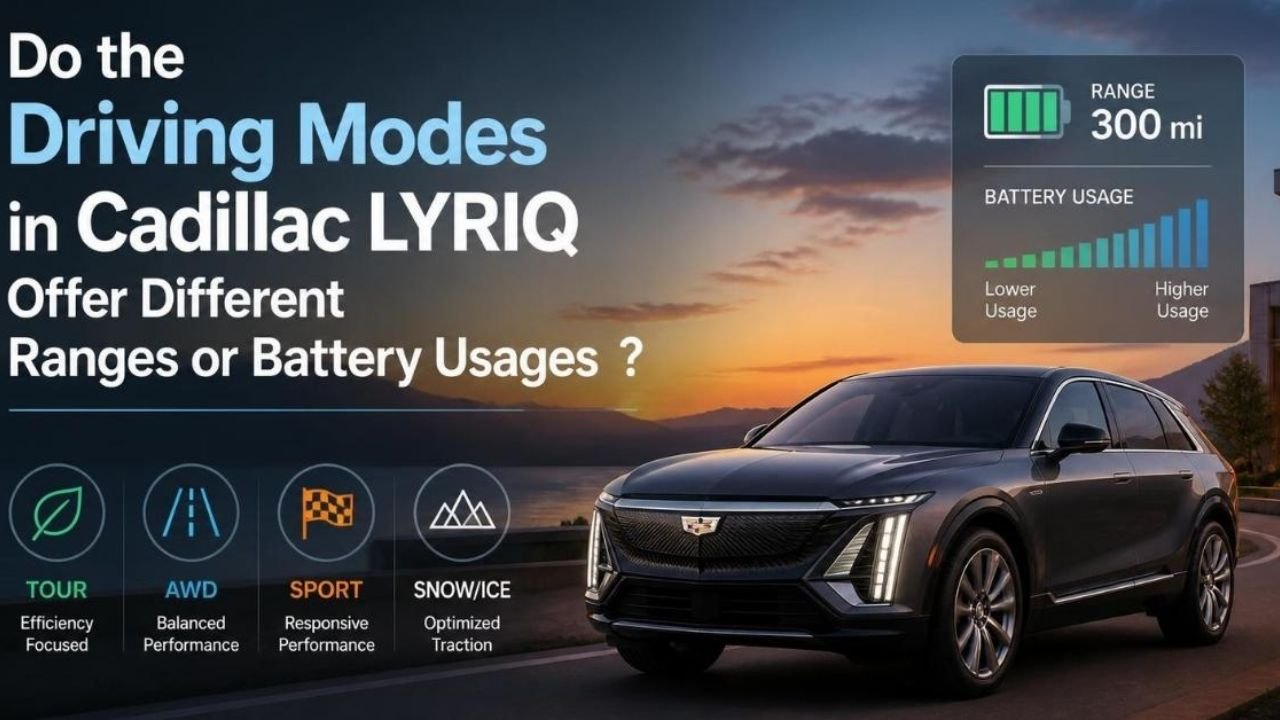
If you own or plan to buy a Cadillac LYRIQ, you may wonder whether Tour Mode, Sport Mode, Snow/Ice Mode, and My Mode affect driving range or battery usage. Do these electric SUV driving modes change how many miles you can travel on a full charge, or do they mainly adjust vehicle response and traction? Understanding the difference between battery capacity, EPA-estimated range, and real-world energy consumption helps answer that question. Each setting serves a different driving purpose, but its effect on Cadillac LYRIQ battery efficiency depends on more than the selected mode.
The LYRIQ’s Driver Mode Control, electric motors, regenerative braking, and One-Pedal Driving all contribute to the driving experience. However, factors such as acceleration habits, highway speed, aerodynamic drag, cold weather, climate control, tire pressure, and road conditions also influence energy use. This guide compares the four driving modes, explains their potential impact on Cadillac LYRIQ range, and shares practical ways to manage battery consumption without relying on unsupported range claims.
Understanding the Cadillac LYRIQ Driving Modes and Their Functions
The Cadillac LYRIQ uses Driver Mode Control to offer different driving characteristics. Depending on the model year, drivetrain, and equipment, available settings may include Tour, Sport, Snow/Ice, and My Mode.
Each setting serves a different purpose. Some focus on everyday comfort, while others prioritize a sharper response or better traction. Understanding these differences helps you choose a suitable setting without assuming that one mode automatically delivers a longer driving range.
Tour Mode for Balanced Everyday Driving
Tour Mode is designed for ordinary driving situations, such as commuting, city travel, and highway journeys. It offers a balanced driving experience without emphasizing the sharper response associated with a sportier setting.
For everyday use, Tour Mode is a sensible starting point. Its driving characteristics may make smooth acceleration easier, but selecting it alone does not guarantee better Cadillac LYRIQ battery efficiency. Your driving habits still matter.
Sport Mode for Sharper Acceleration and Performance
Sport Mode gives the LYRIQ a more responsive driving character. Its accelerator response is designed to feel sharper, allowing the vehicle to react more quickly when you press the pedal.
That response can encourage stronger acceleration. When you repeatedly demand more power from the electric motors, they draw more electricity from the battery. However, simply selecting Sport Mode does not mean the battery will always drain faster.
Snow/Ice Mode for Better Traction and Road Control
Snow/Ice Mode is intended for slippery driving conditions. It adjusts the vehicle’s response to help drivers maintain control when roads are covered with snow, ice, or other slippery surfaces.
This setting prioritizes traction and predictable power delivery rather than performance. Winter journeys can also place additional demands on an electric vehicle because low temperatures, cabin heating, and road conditions may reduce available driving range.
My Mode for Personalized Driving Settings
My Mode allows drivers to personalize available vehicle settings rather than relying entirely on a preset driving character. The adjustments and features available can depend on the LYRIQ’s model year and equipment.
Its effect on Cadillac LYRIQ battery usage depends on the settings selected and how the vehicle is driven. A less aggressive driving response may support smoother acceleration, but My Mode does not guarantee a particular efficiency improvement.
How Different Cadillac LYRIQ Driving Modes Affect Battery Usage and Range
Driving modes influence the vehicle’s behavior, but they do not provide separate battery capacities. Their effect on energy use depends largely on how the driver responds to the selected setting.
For example, a sharper accelerator response may lead to more frequent hard acceleration. A controlled response may encourage smoother inputs. Neither setting can guarantee a specific number of miles per charge because road and weather conditions also affect consumption.
Tour Mode and Its Effect on Battery Efficiency
Tour Mode provides balanced driving characteristics for regular journeys. Drivers who prefer gradual acceleration and a steady pace may find it easier to maintain consistent energy use with this setting.
However, Tour Mode cannot prevent unnecessary battery consumption. Driving at high highway speeds, accelerating aggressively, or using climate control heavily can still reduce efficiency, regardless of the selected mode.
Sport Mode and Increased Energy Consumption
Sport Mode can contribute to higher energy use when drivers take advantage of its sharper response. Rapid acceleration requires substantial power from the electric motors, particularly when moving a large electric SUV.
The actual difference depends on driving behavior. Someone using Sport Mode gently may see little change, while frequent hard acceleration can increase electricity consumption. Therefore, the mode itself should not be treated as a fixed range penalty.
Snow/Ice Mode and Its Impact on Battery Usage
Snow/Ice Mode focuses on controlled power delivery when traction is limited. It can help the driver manage slippery conditions, where sudden acceleration may cause unwanted wheel slip.
Winter driving may also reduce range for reasons beyond the selected mode. Cold temperatures, heating demand, snow-covered roads, and changing tire conditions can all affect how much electricity the vehicle uses.
My Mode and Custom Battery Efficiency Settings
My Mode does not have one universal effect on battery consumption. Its results depend on the adjustments available in your vehicle, the settings you select, and your driving habits.
If your configuration allows a less aggressive response, that choice may help you accelerate more smoothly. Still, steady speeds and sensible driving habits matter more than assuming a customized setting will automatically improve range.
Comparing the Range Impact of Each Cadillac LYRIQ Driving Mode
There is no universal range-loss percentage that applies to Tour, Sport, Snow/Ice, and My Mode. Official EPA-estimated range figures are associated with a vehicle’s tested configuration, not a separate guaranteed range for every driving setting.
A fair comparison requires similar driving conditions. If you want to understand how a mode affects your LYRIQ, compare energy consumption across similar routes while keeping speed, temperature, traffic, and driving habits as consistent as possible.
Tour Mode: What to Expect From Everyday Efficiency
Tour Mode is a practical choice for evaluating everyday energy use because it offers balanced driving characteristics. It suits routine journeys where the driver does not need a particularly sharp accelerator response.
Driving smoothly in Tour Mode can support efficient operation. Nevertheless, your actual estimated range will depend on speed, traffic, temperature, terrain, and the amount of electricity used by the vehicle’s systems.
Sport Mode: Does Faster Acceleration Reduce Range?
Sport Mode may increase energy consumption when it leads to frequent rapid acceleration. The electric motors need more power when the driver demands stronger performance, which can affect the distance available from the battery.
That does not mean every trip in Sport Mode will use noticeably more electricity. A gentle driving style can limit unnecessary power demand, even when the vehicle is set to a more responsive mode.
Snow/Ice Mode: Balancing Traction With Battery Consumption
Snow/Ice Mode should be judged by its main purpose: helping the vehicle maintain control on slippery roads. Its controlled response can be more useful than trying to maximize acceleration or range in difficult conditions.
If your LYRIQ shows reduced range during winter, consider the whole driving environment. Cold weather, cabin heating, road resistance, and tire conditions can contribute to lower efficiency alongside the demands of driving on snow or ice.
My Mode: How Custom Settings Influence Real-World Range
My Mode gives drivers flexibility, but its effect on range depends on the available adjustments. A calmer configuration may support smoother driving, while a more responsive setup may encourage stronger acceleration.
There is no reliable universal figure for the range difference. Consider your usual routes and choose settings that feel comfortable without encouraging unnecessary acceleration or frequent changes in speed.
Practical Things to Consider When Choosing a LYRIQ Driving Mode
The right mode depends on the road and the driving conditions. Tour Mode is suitable for routine travel, Sport Mode offers a sharper response, and Snow/Ice Mode is intended for slippery surfaces.
Think about what matters most before selecting a setting. Performance may be useful in some situations, but traction and control deserve priority when road conditions become difficult. For everyday efficiency, focus on smooth driving rather than relying on a particular mode.
The range displayed by an electric vehicle is an estimate. It can change as driving conditions and recent energy consumption change. A lower estimate after a highway journey does not automatically mean the battery has developed a problem.
Use the vehicle’s energy information to understand consumption over time. Comparing similar journeys is more useful than judging efficiency from one trip with unusual traffic, weather, or elevation changes.
Other Important Factors That Affect Cadillac LYRIQ Battery Range and Energy Consumption
Driving modes are only one part of the Cadillac LYRIQ battery range equation. Several environmental and mechanical conditions influence how much electricity the vehicle needs to cover a particular distance.
Some of these factors can have a greater effect on real-world range than changing between Tour and Sport Mode. Understanding them helps explain why the same vehicle may deliver different efficiency results on different journeys.
Driving Habits and Acceleration Patterns
Your driving style has a direct influence on energy consumption. Repeated hard acceleration requires more power, while unnecessary braking can waste some of the energy previously used to get the vehicle moving.
Smooth driving helps reduce avoidable power demand. Anticipate traffic, leave enough room to slow down gradually, and maintain a consistent pace when conditions allow. These habits can support better efficiency in any driving mode.
Regenerative braking can recover some energy when the vehicle slows down. However, it cannot return all the electricity used during acceleration. Anticipating traffic and avoiding unnecessary speed changes remain useful ways to manage consumption.
Highway Speeds and Aerodynamic Resistance
Highway speed is an important factor affecting electric vehicle range. As the LYRIQ travels faster, aerodynamic drag increases. The vehicle consequently needs more energy to maintain speed against air resistance.
Driving at a moderate, consistent speed can improve efficiency compared with sustained high-speed travel. This is one reason two journeys using the same driving mode may produce different energy-consumption results.
Frequent acceleration and deceleration can also affect consumption. When traffic and road conditions permit, maintaining a steady pace helps avoid unnecessary demands on the electric powertrain.
Weather Conditions and Outside Temperature
Temperature can influence EV battery performance. Cold weather affects battery operation and increases the energy needed to heat the cabin. These demands can reduce the distance available from a charge.
Hot weather can increase consumption as well, particularly when air conditioning operates heavily. Climate control improves passenger comfort, but heating and cooling systems use electricity that would otherwise be available for driving.
Cabin preconditioning can help manage some of this demand. When supported by the vehicle, preparing the cabin while connected to a charger can reduce the battery energy needed to reach a comfortable interior temperature after departure.
Road Terrain, Hills, and Elevation Differences
The terrain also affects battery consumption. Climbing hills requires additional energy because the vehicle must gain elevation. Descending may allow the electric powertrain to recover some energy through regenerative braking.
That recovery does not return every unit of electricity used during the climb. As a result, a hilly journey can produce different efficiency figures from a flat route covering a similar distance.
When planning a longer trip, consider elevation changes alongside distance and expected traffic. This helps explain why two journeys using identical driving settings may not deliver the same range.
Climate Control, Heating, and Air Conditioning
The LYRIQ uses electricity for cabin comfort, including heating and air conditioning. During particularly cold or hot weather, these systems can increase overall energy consumption and leave less stored energy available for driving.
You do not need to turn off climate control to improve efficiency. Instead, use comfortable temperature settings and consider preparing the cabin while the vehicle is connected to external power, where supported.
Tire Pressure, Wheel Size, and Rolling Resistance
Tire pressure affects how efficiently a vehicle moves across the road. Underinflated tires create additional rolling resistance, requiring more energy to maintain movement.
Check tire pressure regularly and follow the manufacturer’s recommended specifications. Overinflating tires is not a safe shortcut to better range. Correct pressure supports handling, tire performance, and vehicle safety.
Wheel size can also influence efficiency. Larger wheels may reduce driving range compared with smaller alternatives, depending on the specific wheel and tire configuration. Check the vehicle’s specifications when comparing different LYRIQ versions.
Regenerative Braking and Energy Recovery
Regenerative braking converts some of the vehicle’s movement energy into electricity during deceleration. The system can return part of that energy to the battery rather than losing all of it through conventional braking.
The amount recovered depends on driving conditions, speed, battery state, and system operation. One-Pedal Driving, where equipped, can make controlled deceleration more convenient and help drivers use energy recovery during everyday journeys.
How to Optimize Cadillac LYRIQ Battery Usage and Maintain Long-Term Battery Health
Improving Cadillac LYRIQ battery efficiency involves more than selecting Tour Mode. Driving habits, charging practices, temperature management, and regular maintenance all contribute to how effectively the vehicle uses its available energy.
Efficient driving and long-term battery care are related, but they are not the same thing. Reducing unnecessary energy consumption can help with everyday range, while following Cadillac’s charging and maintenance recommendations supports proper battery care.
Follow Suitable EV Charging Habits
Good EV charging habits help you manage the battery according to your daily driving requirements. You do not necessarily need to charge to the maximum level every day when your regular journeys require much less energy.
Follow the charging guidance in your LYRIQ owner’s manual. For longer journeys, plan your charge level around the expected distance and available charging facilities. Use the manufacturer’s recommendations rather than assuming one charging routine suits every owner.
Use Battery and Cabin Preconditioning
Battery preconditioning helps bring the battery toward a suitable operating temperature under supported conditions. It may be useful when preparing for certain charging sessions or operating the vehicle in demanding temperatures.
Cabin preconditioning serves a different purpose: it prepares the interior before you begin driving. When connected to external power, this can reduce the initial battery demand associated with heating or cooling the cabin.
Maintain Proper Tire Pressure and Vehicle Components
Regular maintenance supports efficiency and safe vehicle operation. Check tire pressure, inspect tire condition, and follow the recommended maintenance schedule instead of waiting until you notice a change in driving performance.
The LYRIQ also relies on properly functioning brakes, cooling systems, and other vehicle components. Follow Cadillac’s maintenance instructions and have warning messages or unusual changes in performance checked by a qualified service professional.
Monitor Battery Consumption and Driving Efficiency
The vehicle’s energy information can help you understand how driving conditions influence consumption. Look at results across comparable journeys instead of judging performance from one unusually short or difficult trip.
Compare routes with similar speeds, temperatures, and terrain whenever possible. This makes it easier to identify whether acceleration habits, climate control, or road conditions are contributing to changes in energy use.
Frequently Asked Questions
Do Cadillac LYRIQ Driving Modes Change the Driving Range?
Cadillac LYRIQ driving modes do not change the battery’s physical capacity or the vehicle’s official EPA-estimated range. However, they can influence real-world energy consumption through changes in vehicle response and driving behavior. Acceleration, speed, temperature, terrain, and climate control also affect how far the vehicle travels on a charge.
Which Cadillac LYRIQ Driving Mode Is Best for Battery Efficiency?
Tour Mode is a sensible option for everyday driving because it provides balanced driving characteristics. However, selecting Tour Mode does not guarantee maximum range. Smooth acceleration, moderate highway speeds, correct tire pressure, and sensible climate control use can help manage energy consumption regardless of the selected driving mode.
Does Sport Mode Use More Battery Power in the Cadillac LYRIQ?
Sport Mode provides a sharper driving response, which may encourage stronger acceleration. Frequent hard acceleration requires more power from the electric motors and can increase battery consumption. However, the actual difference depends on driving habits, speed, traffic, and road conditions. Selecting Sport Mode does not create a fixed range penalty.
Does Snow/Ice Mode Affect Cadillac LYRIQ Battery Range?
Snow/Ice Mode prioritizes controlled power delivery and traction on slippery roads. Winter conditions can also reduce electric vehicle range because cold temperatures affect battery operation and cabin heating requires electricity. Snow-covered roads and changing tire conditions may contribute to additional energy consumption during winter journeys.
How Can You Improve Cadillac LYRIQ Battery Efficiency?
You can manage Cadillac LYRIQ energy consumption by accelerating smoothly, maintaining recommended tire pressure, and avoiding unnecessarily high highway speeds. Use regenerative braking where appropriate and consider cabin preconditioning while connected to a charger. Follow Cadillac’s charging and maintenance recommendations for your specific model year.
Conclusion
Cadillac LYRIQ driving modes influence vehicle response and traction, but they do not change physical battery capacity or official EPA range ratings. Tour Mode offers balanced everyday driving, Sport Mode prioritizes responsiveness, Snow/Ice Mode supports traction, and My Mode provides customization. Real-world range also depends on speed, temperature, acceleration, terrain, and climate control. To manage energy use, drive smoothly, maintain correct tire pressure, and use regenerative braking where appropriate. Follow Cadillac’s charging guidance to support battery care. Understanding these factors helps you choose suitable settings and make better use of each charge.

I’m Asma, founder of namessaaga.com, passionate about helping brands and startups discover unique, creative, and memorable names that stand out.