Have you heard someone say “No manches” or “No mames” and wondered what they really mean? These Mexican Spanish expressions can sound confusing because their English meaning changes with the situation. Both are common in casual conversations, texts, social media, and chats, but they do not carry the same level of intensity. One is milder, while the other is more vulgar and should be used carefully.
The difference between No Manches vs. No Mames, including their meanings, English equivalents, tone, pronunciation, and everyday examples. You’ll also learn when each phrase fits naturally and which expression to choose in different social situations.
No Manches vs. No Mames meaning: What Do They Mean and When to Use Them?
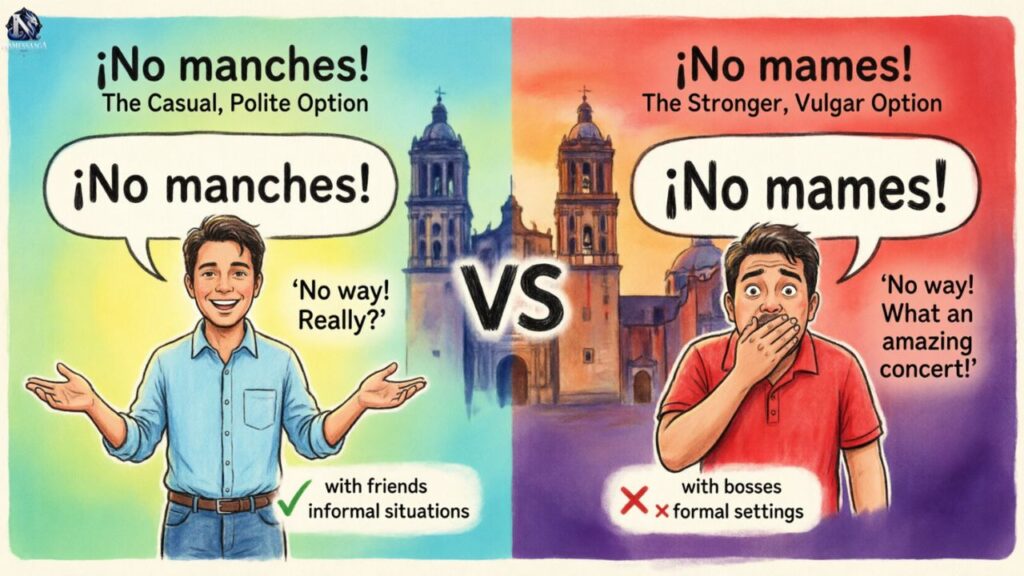
No manches and no mames are common expressions in Mexican Spanish that can show surprise, disbelief, frustration, or shock. In English, they may translate to phrases such as “no way,” “you’re kidding,” “seriously?” or “come on,” depending on the situation and tone. While they are closely related, they do not have the same level of intensity.
The main difference is social tone and vulgarity. No manches is the milder, more widely acceptable expression, while no mames is stronger and more vulgar, making it better suited to informal conversations with people who are comfortable with that kind of slang. Knowing the context, relationship, and way the phrase is spoken can help you understand what a Mexican Spanish speaker means and choose the appropriate expression.
What Does No Manches Mean?
No manches is a Mexican Spanish slang expression used to show surprise, disbelief, shock, or mild frustration. In English, it can mean “no way,” “you’re kidding,” “seriously?” or “come on,” depending on the situation. You may hear it in casual conversations, text messages, social media posts, or messages between friends and family.
The expression is generally considered a milder alternative to “no mames,” so it sounds less vulgar while still being informal. Its exact meaning often depends on the speaker’s tone and context. A playful “¡No manches!” can show amused disbelief, while a short or serious delivery may express annoyance or frustration.
Key Differences Between “No Manches” and “No Mames”
No manches and no mames can both express surprise, disbelief, shock, or frustration in Mexican Spanish, but their tone is different. No manches is the milder expression and is often used in casual conversations, texts, and social media. No mames is stronger and contains vulgar slang, so it is generally reserved for very informal situations, especially among close friends who are comfortable speaking that way.
A playful “¡No manches!” may mean “No way!” or “You’re kidding,” while “¡No mames!” can sound much more intense, depending on the situation. Neither expression is a good choice for formal writing, professional communication, or situations where you are unsure about the other person’s comfort with Mexican slang.
When and How to Use Them
Use no manches in casual Mexican Spanish when you want to react to surprising news, disbelief, frustration, or something unexpected. It works naturally in conversations with friends, family, and other people you know well, as well as in informal texts and social media. If you are unsure which expression fits, no manches is usually the better choice because it is milder and less vulgar than no mames.
Use no mames more carefully because it is stronger, vulgar slang and is best kept for very informal conversations with close friends who are comfortable with that language. Neither expression belongs in formal writing, professional messages, customer communication, or other situations where a respectful, neutral tone is expected. Your relationship with the speaker, the setting, and your tone of voice all help determine whether the phrase sounds playful, surprised, or annoyed.
Read More : Duke Dennis Real Name: Full Biography, Age, Net Worth, Height & More
Cultural Note: The Humor Behind These Phrases
In Mexican Spanish, no manches and no mames are more than direct translations of “no way” or “you’re kidding.” Their humor often comes from the speaker’s tone, facial expression, relationship with the listener, and the situation. Among friends, either phrase can turn an unexpected or ridiculous moment into a playful reaction. The stronger wording of no mames can also add emphasis when people are joking with each other.
- No manches: A milder, playful reaction to something surprising, funny, or hard to believe.
- No mames: A stronger and more vulgar reaction that can sound humorous among close friends.
- Tone matters: A stretched or exaggerated delivery can make the expression sound playful rather than angry.
- Mexican culture: These phrases are part of informal Mexican Spanish and reflect the expressive style of everyday conversation.
- Context matters: The same words can feel funny, surprised, annoyed, or confrontational depending on the situation.
Tips for English Speakers Learning These Phrases
For English speakers learning Mexican Spanish, no manches and no mames are best understood through real conversations rather than word-for-word translation. Their meaning can shift with tone and context, so listen to how native speakers use them in conversations, videos, texts, and social media before using them yourself. Start with no manches because it is the milder expression and is generally easier for learners to use appropriately.
- Learn the context: Notice whether the speaker is expressing surprise, disbelief, amusement, or frustration.
- Start with no manches: It is less vulgar than no mames and is a safer informal choice.
- Listen to pronunciation: Pay attention to stress, rhythm, and intonation in Mexican Spanish.
- Watch the tone: A playful delivery can sound very different from an angry or serious one.
- Know your audience: Keep stronger slang for close friends who already use it comfortably.
- Avoid formal settings: Use neutral expressions such as “¿En serio?” or “¡No puede ser!” in professional or formal situations.
No Mames in English
No mames does not have one exact English translation because its meaning changes with the situation and the speaker’s tone. In Mexican Spanish, it is a strong, vulgar expression that can communicate “no way,” “you’re kidding,” “are you serious?” “come on,” or “you’ve got to be kidding me.” It can express surprise, disbelief, amusement, frustration, or annoyance rather than serving as a literal sentence.
- “No way!” — when reacting to surprising news.
- “You’re kidding!” — when something seems unbelievable.
- “Are you serious?” — when questioning something unexpected.
- “Come on!” — when showing frustration or disbelief.
- “You’ve got to be kidding me!” — when the reaction is especially strong.
- Tone matters: Among close friends it can sound playful, but in another setting it may come across as rude or vulgar.
- Formal English equivalent: There is no single formal translation; neutral phrases such as “Really?” or “I can’t believe it” may fit better.
No Mames Meaning
No mames is a vulgar Mexican Spanish slang expression used to show strong surprise, disbelief, shock, amusement, or frustration. In English, it can mean “no way,” “you’re kidding,” “are you serious?” or “come on,” depending on context and tone.
- Language: Mexican Spanish
- Tone: Strong and informal
- Common use: Casual conversation, texting, and social media
- Best context: Close friends and informal situations
- Avoid: Formal, professional, or unfamiliar settings
The Softening Ladder
Mexican Spanish has several ways to react to surprising or unbelievable news, and their strength can vary. No mames is the strongest and most vulgar of these common expressions, while no manches offers a milder alternative. Softer choices help English speakers match their language to the situation without sounding unnecessarily rude.
- No mames: Strong and vulgar.
- No manches: Milder, informal slang.
- No inventes: Softer reaction meaning “don’t make things up.”
- ¿En serio?: Neutral and suitable for almost any situation.
When You Are Not Sure, Say No Manches
If you are learning Mexican Spanish and unsure which reaction fits, no manches is generally the safer choice. It can express surprise, disbelief, amusement, or mild frustration without the stronger vulgar tone associated with no mames.
- Use no manches: In casual conversations and informal messages.
- Choose no mames carefully: Reserve it for close friends and relaxed settings.
- Stay neutral: In formal situations, use ¿En serio? or ¡No puede ser!
No Manches Wey Meaning
No manches, wey is an informal Mexican Spanish expression used to show surprise, disbelief, amusement, or frustration. In English, it can sound like “No way, dude!”, “You’re kidding, bro!”, or “Come on, man!” depending on the situation and tone.
- No manches: A milder reaction to something unexpected.
- Wey/güey: Informal Mexican slang for “dude,” “bro,” or “man.”
- Tone: Usually casual and familiar.
- Best use: Informal conversations with friends.
- Avoid: Formal, professional, or unfamiliar settings.
Listen to How It Is Said
The meaning of no manches can change with the speaker’s tone, intonation, and delivery. A drawn-out “no maaanches” may sound playful or amused, while a short, sharp version can express genuine disbelief, irritation, or frustration. Listening to native Mexican Spanish speakers can help you understand these subtle differences.
Pay attention to the conversation, facial expression, and relationship between the speakers. In a text message or social media comment, emojis and surrounding words can provide similar clues. Understanding these signals helps English speakers interpret Mexican slang more accurately instead of relying on a single English translation.
Read More : WFH Meaning: Benefits, Challenges, and Essential Tools
Frequently Asked Questions
What does “no manches” mean in English?
“No manches” can mean “no way,” “you’re kidding,” “seriously?” or “come on,” depending on the context and tone.
What does “no mames” mean in English?
“No mames” is a stronger Mexican slang expression that can mean “no way,” “you’ve got to be kidding,” “are you serious?” or “come on.”
What is the difference between “no manches” and “no mames”?
Both express surprise, disbelief, or frustration, but no manches is milder, while no mames is more vulgar and stronger.
Is “no mames” a bad word?
Yes, “no mames” is considered vulgar Mexican slang. It is common among close friends but is better avoided in professional or formal situations.
Is “no manches” a bad word?
“No manches” is not as vulgar as “no mames,” but it is still informal slang. It is generally more socially acceptable in casual conversations.
Why do Mexicans say “no mames”?
Mexicans use “no mames” to show strong surprise, disbelief, frustration, amusement, or shock. Its exact meaning depends on the situation and tone.
What does “no manches, wey” mean?
“No manches, wey” is an informal way to say “No way, dude!” or “You’re kidding, bro!” Wey/güey means “dude” or “bro” in casual Mexican Spanish.
Can you say “no mames” at work?
It is best to avoid “no mames” at work because it is vulgar and very informal. Use phrases like “¿En serio?” or “¡No puede ser!” in professional settings.
Conclusion
No Manches vs. No Mames meaning helps you use Mexican slang more naturally and avoid saying something too strong for the situation. Both expressions can show surprise, disbelief, frustration, or excitement, but they differ in tone. No manches is the milder choice, while no mames is stronger and vulgar. Your relationship with the person, setting, and tone all matter.
If you are learning Mexican Spanish, start with no manches in casual conversations and pay attention to how native speakers use it. Save no mames for informal situations where you know the people well. For work or formal conversations, choose neutral phrases such as “¿En serio?” or “¡No puede ser!” instead.

I’m Asma, founder of namessaaga.com, passionate about helping brands and startups discover unique, creative, and memorable names that stand out.