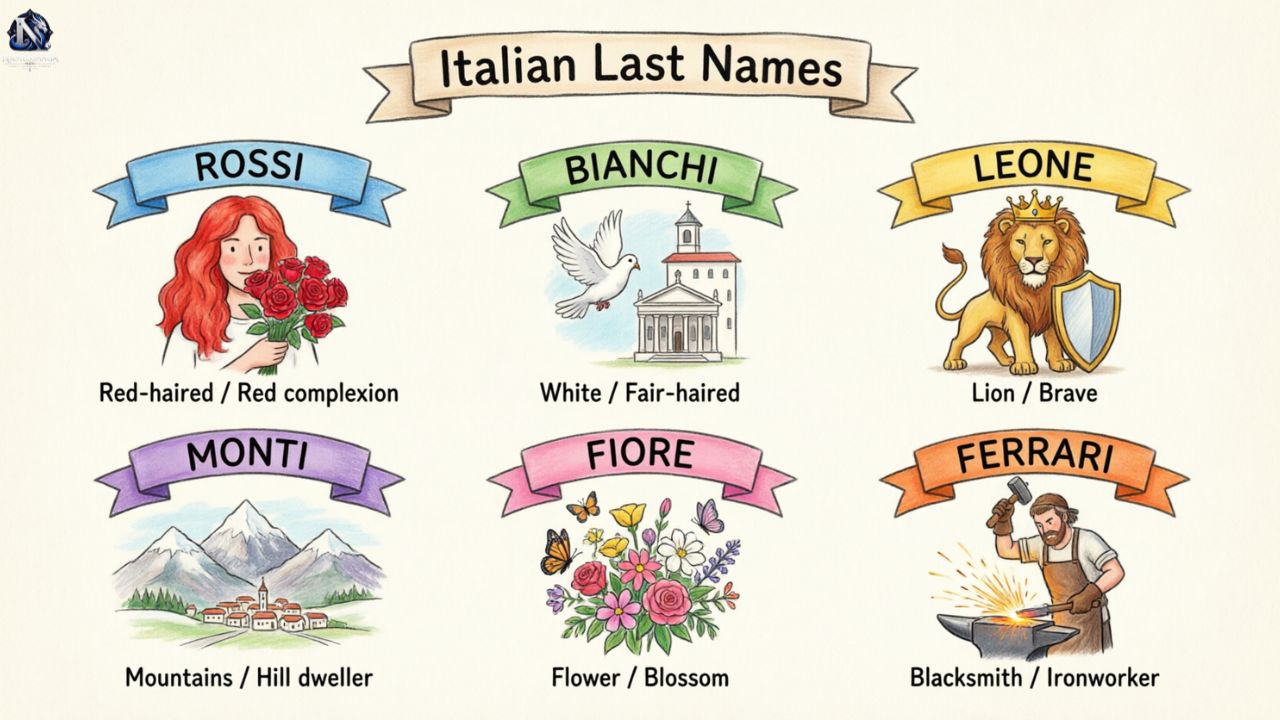
Italian last names fall into four main types. They started as a trade name like Ferrari for blacksmith, a physical trait like Rossi for red hair, a hometown like Romano for Rome, or a father’s name like Di Marco for son of Marco. Knowing which type your surname fits is the fastest way to understand where it came from.
This guide breaks down real Italian surnames by category, shows how they spread across Italy and into the United States, and explains what a surname can tell a descendant about their family history. Sources include the Enciclopedia Treccani, the Italian National Institute of Statistics, the Cognomix surname database, and FamilySearch.
How Italian Surnames Started
Hereditary surnames were not common in Italy until the twelfth through sixteenth centuries, and they spread slowly, starting with nobility and city merchants before reaching the wider population. Civil registration during the Napoleonic period in the early 1800s pushed most remaining families toward a fixed, recorded name. After Italy unified in 1861, local civil registries called stato civile made surname recording standard nationwide.
No single agency has ever published a complete, certified count of every Italian surname. Linguist Emidio De Felice built the first major surname count in the 1970s using telephone subscriber lists, a method that undercounted women and people without phone service at the time. Later studies refined that approach, and current estimates place the total number of distinct Italian surnames between 300,000 and 400,000. That range is why rankings beyond the handful of most common names shift slightly from one study to the next.
Before the Napoleonic reforms, naming practices varied widely by region and by social class. A noble family in a city state like Venice or Florence might have carried a fixed surname for generations before an ordinary farming family in the same region did, simply because land ownership and legal contracts required a stable name for inheritance purposes. Rural families, by contrast, were often still identified informally by a father’s name or a local nickname well into the eighteenth century, which is part of why patronymic and descriptive surnames remain so common in Italy today.
Comparing the Four Types of Italian Surnames
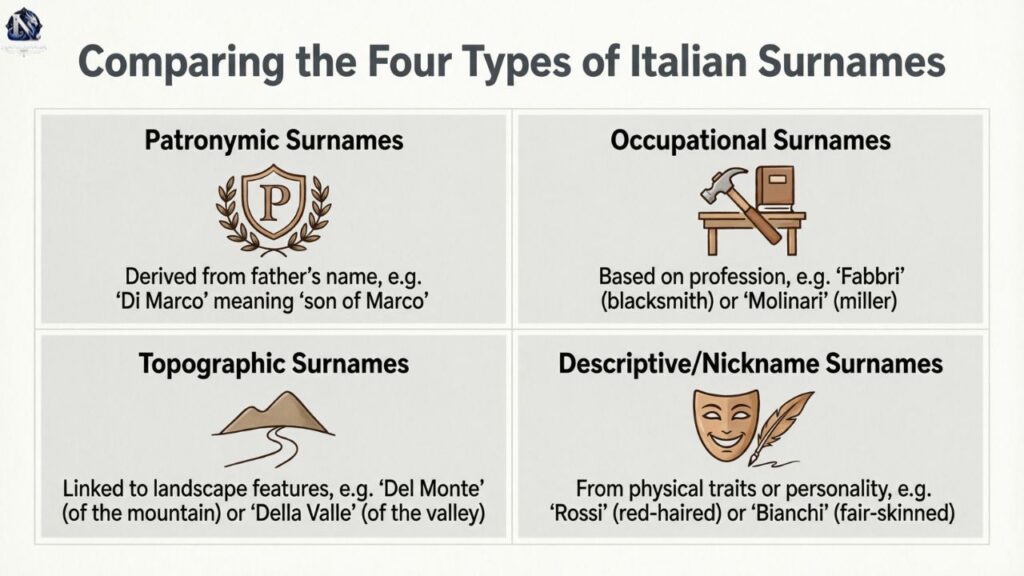
| Type | What It Describes | Example | Meaning |
| Occupational | A family trade or job | Ferraro | Blacksmith |
| Descriptive | A physical trait or personality | Rossi | Red, for hair or complexion |
| Toponymic | A hometown or region | Romano | From Rome |
| Patronymic | A father’s or ancestor’s first name | Di Marco | Son of Marco |
Most Common Italian Last Names
Rossi is the most common surname in Italy, and Russo, its southern dialect equivalent, ranks close behind. Both mean red. Ferrari, meaning blacksmith, is the third most common. These rankings come from decades of directory and registry based research summarized by Treccani and the Cognomix database.
| Rank | Surname | Meaning | Region Most Concentrated |
| 1 | Rossi | Red | Northern Italy |
| 2 | Russo | Red | Southern Italy |
| 3 | Ferrari | Blacksmith | Nationwide |
| 4 | Esposito | Exposed, historically given to foundlings | Naples and Campania |
| 5 | Bianchi | White | Northern Italy |
| 6 | Romano | From Rome | Central and Southern Italy |
| 7 | Colombo | Dove | Lombardy |
| 8 | Ricci | Curly haired | Nationwide |
| 9 | Marino | Sailor, or of the sea | Coastal regions |
| 10 | Greco | Greek | Southern Italy |
| 11 | Bruno | Brown | Nationwide |
| 12 | Gallo | Rooster | Southern Italy |
| 13 | Conti | Count | Nationwide |
| 14 | Mancini | Left handed | Central Italy |
| 15 | Costa | Coast | Coastal regions |
Read More : 350+ Clown Names: Funny, Scary, Classic, and Meme-Era Ideas
What Italian Surnames Mean by Category
Occupational surnames marked a family trade, and many stayed in use long after the trade disappeared. Descriptive surnames captured a physical trait or personality that outsiders used to identify someone. Toponymic surnames pointed to a hometown, region, or natural feature. Patronymic surnames used a father’s first name, often with the prefix Di or De, meaning of or son of.
| Category | Surname | Meaning |
| Occupational | Fabbri | Smith or craftsman |
| Occupational | Sartori | Tailor |
| Occupational | Pastore | Shepherd |
| Occupational | Pellegrini | Pilgrim |
| Descriptive | Piccolo | Small |
| Descriptive | Grasso | Heavyset |
| Descriptive | Calvo | Bald |
| Descriptive | Forte | Strong |
| Toponymic | Napoletano | From Naples |
| Toponymic | Siciliano | From Sicily |
| Toponymic | Fiorentino | From Florence |
| Toponymic | Sardo | From Sardinia |
| Patronymic | D’Angelo | Son of Angelo |
| Patronymic | Di Stefano | Son of Stefano |
| Patronymic | De Simone | Son of Simone |
| Patronymic | Benedetti | Descended from Benedetto |
Some surnames fall outside these four categories entirely. Esposito is one of the clearest examples. It comes from the Latin word for exposed and was historically given by church officials to abandoned infants in Naples, which is why the name remains heavily concentrated in that region today. Similar foundling surnames exist elsewhere in Italy under different spellings, including Innocenti in Tuscany and Proietti in parts of central Italy, both tied to the same historical church practice of naming children left at orphanages or hospital doors.
Rare and Regional Italian Surnames
Not every surname spread nationwide. Some stayed limited to a single province or even a single town for centuries, which makes them especially useful for genealogy since the name itself narrows down a family’s likely origin.
| Surname | Where It Concentrates | Note |
| Musumeci | Sicily | Shows Arabic linguistic influence from Sicily’s medieval history |
| Sanna | Sardinia | One of the most common surnames on the island |
| Piras | Sardinia | Common alongside Sanna in the same region |
| Bileggi | Umbria and Sicily | Documented as limited almost entirely to one frazione near Foligno and to Catania |
| Malaspina | Liguria | Tied to a historic noble family, meaning bad thorn |
| Trevisan | Veneto | Toponymic, from the city of Treviso |
| Cabras | Sardinia | Also the name of a Sardinian coastal town |
| Tafuri | Puglia | Concentrated in the southern Adriatic coast region |
Famous and Historic Italian Surnames
Several Italian surnames carry weight because of a specific historical family, not just because they are common today.
| Surname | Historical Connection |
| Medici | Banking and political family that shaped Renaissance Florence |
| Sforza | Ruling family of Milan |
| Savoia | Former royal House of Savoy in Italy |
| Borgia | Powerful family tied to the Papacy during the Renaissance |
| Colonna | One of Rome’s oldest noble families |
| Fermi | Surname of physicist Enrico Fermi |
| Puccini | Surname of composer Giacomo Puccini |
| Montessori | Surname of educator Maria Montessori |
How Italian Names Changed in America
Ellis Island inspectors did not rename Italian immigrants on arrival. Historians and the National Park Service, which oversees Ellis Island’s historical records, have corrected this myth repeatedly. Inspectors worked from ship manifests written before departure, so they had little reason to alter spelling during processing. Most surname changes happened later, after families settled in cities such as New York, Boston, Providence, and Chicago, when immigrants or their children simplified spelling or translated a name into English to fit into their new community.
Common patterns include dropping a final vowel or translating a name outright, such as Bianco becoming White. Recognizing these patterns helps a researcher trace an Americanized surname back to its original Italian spelling in church and civil records.
What Your Surname Reveals About Family History
A surname often points a researcher toward a region before any document does. Toponymic names like Napoletano or Siciliano name a region directly. Occupational names like Ferraro or Pastore hint at the kind of work a family did, which often shaped where they lived. Even a widely spread name like Rossi carries regional signal, since Rossi concentrates in the north while its southern equivalent, Russo, concentrates in the south.
This regional pattern matters for genealogy because Italian civil records were kept locally by comune, the smallest Italian administrative unit, not nationally, until well into the modern era. Researchers typically start with a best guess at a comune based on the surname, then search that town’s parish and civil registry directly.
A useful next step is checking baptismal, marriage, and death records held at the parish level, since these often predate national civil registration by well over a century. Many Italian dioceses have digitized these records through the Antenati portal run by the Italian State Archives, which lets researchers search scanned original documents by comune and surname without traveling to Italy. Combining a surname’s likely regional origin with a targeted Antenati search is usually faster than starting with a broad national database search.
Where Italian American Surnames Trace Back To
Most Italian surnames common in the United States today trace to two major immigration waves. The larger wave, between 1880 and 1924, came mostly from southern Italy and Sicily, bringing names like Esposito, Russo, Greco, and Caruso into cities such as New York, Boston, and New Orleans. An earlier and smaller wave, concentrated in the decades just after Italian unification in 1861, drew more heavily from northern Italy, bringing names like Rossi, Colombo, and Bianchi into cities such as San Francisco and Chicago.
This split explains a pattern many Italian American families notice once they start researching. A surname common on the East Coast, especially in older Italian neighborhoods in New York or Providence, often traces to Naples, Sicily, or Calabria. A surname more common in parts of California traces more often to Liguria, Tuscany, or Lombardy. Neither pattern is absolute, but it is a useful starting point before searching parish and civil records directly.
Choosing an Italian Surname for Names or Characters
Writers and researchers sometimes need an authentic sounding Italian surname rather than a family history lookup. A few practical checks keep the result accurate instead of invented. Match the surname type to the background you want, using an occupational name for a working family or a toponymic name for someone tied to a specific region. Confirm the name fits a real regional pattern, since a Sardinian surname like Sanna reads very differently than a Sicilian surname like Musumeci. Watch prefix grammar carefully, since Di, De, Del, Della, and D’ each follow different rules depending on whether they attach to a person’s name or a place. Finally, cross check any chosen name against a distribution database such as Cognomix to confirm it is a real, documented surname rather than an invented one.
Frequently Asked Questions
What is the most common Italian last name?
Rossi holds that spot in most surname studies, with Russo and Ferrari close behind. Rossi and Russo actually share the same root meaning, red, and mainly differ by region. Rossi is more common in the north, while Russo dominates the south. Together, these three names cover a large share of the Italian population today.
What does my Italian last name mean?
Check which of four buckets it fits. Occupational names describe a trade, like Ferraro for blacksmith. Descriptive names describe a trait, like Rossi for red hair. Toponymic names name a place, like Romano for Rome. Patronymic names use a father’s first name, like Di Marco for son of Marco. Most surnames fit clearly into one of these.
Did Ellis Island really change Italian last names?
No, and this gets corrected often by historians. Ellis Island staff worked directly from ship manifests written before the voyage, so they had no real opening to rename anyone during inspection. Most name changes happened afterward, once families had settled in America and adjusted their spelling themselves, often to fit in more easily with English speaking neighbors.
How can I find out what region of Italy my surname is from?
Start with the name type. Toponymic surnames like Napoletano or Siciliano point straight to a region. For less obvious names, a surname distribution database such as Cognomix shows exactly where a name concentrates across Italy today, which usually narrows your search down to just one or two provinces worth investigating further.
Why do so many Italian surnames end in the letter i?
Because many Italian surnames are grammatically plural. A name like Rossi originally referred to the whole Rossi family, not one person. That final i marks the plural family form. This is also why you will rarely see an Italian surname described as singular in older civil or church records, even for a single household.
What is the difference between Di and Della in Italian surnames?
Di generally means of or son of and introduces a father’s first name, as in Di Marco. Della means of the and attaches to a place or object rather than a person, as in Della Valle, meaning of the valley. Mixing these up is a common but easy to avoid mistake.
Is Romano an Italian or a Jewish surname?
Romano is a well documented Italian toponymic surname meaning from Rome. A similar spelling also exists separately as a Jewish surname in unrelated communities. The real origin for any specific family depends on that family’s own documented history, not on the surname by itself, so this one needs individual research rather than a single blanket answer.
Do Italian surnames always pass through the father’s side?
Historically, yes, following the same patronymic logic that shaped the surnames themselves. Current Italian civil law now allows some families to register a double surname combining both parents’ names. So while the traditional pattern still dominates older records, it is no longer an absolute rule for newer generations born under updated Italian naming law.
Conclusion
Italian last names are more than words on a passport or a family tree. Each one carries a small piece of history, a trade, a hometown, or a father’s name passed down for centuries. Whether your surname is common like Rossi or rare like Bileggi, it can point you toward the region your family came from and the life they lived before crossing the Atlantic.
If you are researching your roots, start with the surname type, check a distribution database, and look into local parish records. Understanding Italian last names is often the first real step toward finding your family’s story, one name, one record, and one generation at a time.

I’m Asma, founder of namessaaga.com, passionate about helping brands and startups discover unique, creative, and memorable names that stand out.